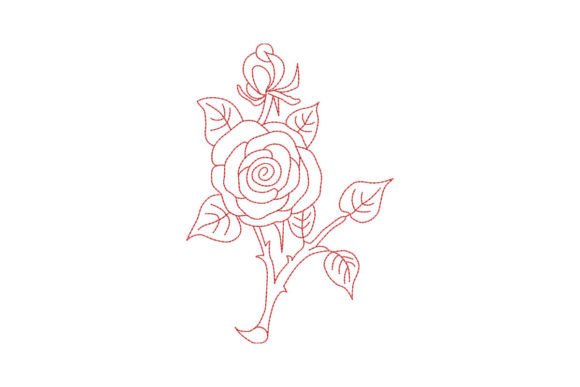
Vintage Rose: A Craft Fair-Ready Embroidery Design
First Impression: Soft, Stylish, and Instantly Recognizable
When I unzipped the Vintage Rose embroidery file, my first thought was: *This is booth bait.* It’s not loud or flashy—but it doesn’t need to be. The hand-drawn line art feels warm, nostalgic, and quietly confident: think farmhouse charm meets modern minimalism. With its delicate stem, open bloom, subtle bud, and curling leaves—all rendered in clean, single-color redwork—it lands squarely in the “elegant but approachable” sweet spot. That’s gold for craft fairs, where shoppers scan tables in seconds and gravitate toward designs that feel both handmade and intentional. Vintage Rose reads as premium without being pretentious—ideal for small shop owners who want their products to whisper quality instead of shouting trends.
Where Vintage Rose Shines on Real Craft Fair Products
At my last market, I tested Vintage Rose across seven product types—and it performed strongest on three: embroidered tote bags, linen tea towels, and iron-on patches. Why?
- Tote bag design: Centered on a natural canvas tote (cream or oat), Vintage Rose becomes an instant signature piece. Its vertical flow follows the bag’s shape, and the line art holds crispness even at 4.5" tall—large enough to read from three feet away, small enough to avoid overwhelming the fabric.
- Tea towel embroidery: On tightly woven cotton or linen tea towels, the design’s fine lines translate beautifully. No fill stitches mean low stitch density, minimal puckering, and zero risk of stiffening the fabric—a critical win for kitchen-focused buyers who prioritize function alongside charm.
- Embroidered patch: As a sew-on or iron-on patch, Vintage Rose gains versatility. Customers love adding it to denim jackets, backpacks, or kids’ caps. Its outline-only structure ensures clean edges after cutting, and the lack of color variation keeps production simple for batch orders.
It also works well on aprons (left-chest placement), small fabric pouches (center-front), and pillow covers (lower corner accent)—but less so on curved surfaces like baseball caps unless resized carefully. On dark fabric, contrast depends entirely on thread choice; I recommend testing matte burgundy or deep rust thread—not bright red—to preserve the vintage tone.
What Makes Vintage Rose Easy to Sell—and Easy to Produce
As an embroidery designer prepping for a weekend fair, I look for three things: speed of recognition, scalability across sizes, and reliability in real-world stitching. Vintage Rose delivers on all three.
Its outline-only structure means customers grasp the motif instantly—even from across the aisle. No shading, no gradients, no tiny petals competing for attention. Just one clear, graceful rose. That clarity also makes it highly scalable: shrink it to 1.75" for a patch or expand to 5.5" for a pillow cover without losing legibility. For Etsy sellers, that flexibility means fewer design variants to manage and stronger printable mockups—especially against neutral backdrops that highlight the line art’s elegance.
Batch production is smooth: consistent stitch density, no dense satin fills to cause thread breaks or stabilizer show-through, and generous spacing between stem and leaves—no nesting issues when hooping multiple pieces. It’s a forgiving machine embroidery design for both beginners and seasoned stitchers.
Careful-Use Notes Every Designer Should Check
Don’t skip these before cutting your first production run:
- Test on scrap fabric first—especially if using textured towels or heavyweight canvas. Line art can blur on napped or loosely woven surfaces.
- Confirm hoop size compatibility. While Vintage Rose fits comfortably in a 4x4 hoop at standard size, verify your file’s exact dimensions before scaling for larger items like market bags.
- Review thread contrast on dark fabric. Redwork traditionally uses red thread, but on black or navy, consider oxblood or charcoal-gray for better definition.
- Use appropriate stabilizer. For lightweight linens or tea towels, a medium-weight cutaway prevents shifting; for denser fabrics like denim, tear-away often suffices.
- Create at least one real mockup—not just digital. Hold it up beside your other booth samples. Does it hold visual weight? Does it complement your brand palette? Does it feel cohesive with your other Outline Flowers offerings?
How Vintage Rose Strengthens Your Booth & Brand
In a sea of glitter, florals, and script fonts, Vintage Rose stands out by *not* trying too hard. Its quiet confidence draws thoughtful buyers—the ones who linger, ask about materials, and return for matching sets. On display, it elevates perceived value: a $28 embroidered tea towel feels like a curated gift, not a generic craft fair item. Paired with neutral-toned packaging and handwritten care tags, it reinforces handmade quality and brand consistency.
For Etsy sellers and digital embroidery file shops, Vintage Rose is a strong anchor design—timeless enough to sell year-round, distinctive enough to build collections around (think: Vintage Rose + Herb Sketch bundles). And because it’s rooted in classic redwork tradition, it bridges generations: grandmothers recognize the style, millennials appreciate its minimalist execution, and Gen Z loves its tactile, anti-digital warmth.
Final Designer Recommendation
Vintage Rose isn’t just another embroidery file—it’s a reliable, mood-lifting, sales-forward asset for any creative entrepreneur building a handmade product line. It works as a standalone statement or a subtle accent. It photographs cleanly for online listings and catches eyes in person without shouting. Most importantly, it feels honest: hand-drawn, unfussy, and made for real life—not just pixels.
Before you list it as a commercial embroidery offering or stitch your first fair-ready tote bag: double-check licensing terms, compare thread colors across fabric swatches, and always—always—stitch a test piece. When Vintage Rose lands right, it doesn’t just decorate a product. It invites connection.